
Free skin cancer screenings this week in Colorado (see link for detail)
Boulder 6/3/09
Aurora 6/4/09
Lakewood 6/6/09
Littleton 6/7/09
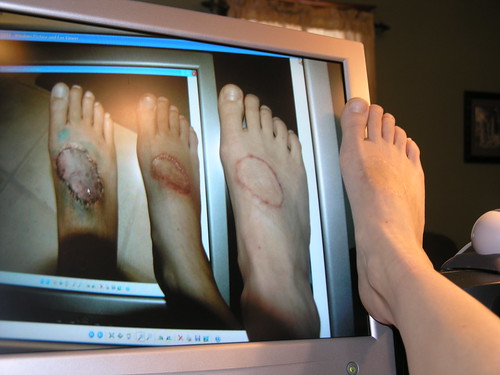


Woman Battles Melanoma In Real-Life 'Grey's Anatomy' Story
Naomi Williams, 29, was watching a recent episode of the ABC hospital drama Grey's Anatomy, on which Katherine Heigl's character, Izzy Stevens, is battling advanced skin cancer but had to stop because her own experience with skin cancer was still too fresh to endure seeing it unfold on screen."The timing is very surreal," said Williams, who lives in Jacksonville, Fla. "It was really intense... too difficult to watch for me."Like Heigl's character, Williams was diagnosed with stage 4 melanoma -- the most serious type of skin cancer -- about one month ago. The cancer was discovered after she broke a bone in her back bending down to put a plug in a socket. Subsequent tests revealed that she had cancer in her bones and her lungs."That was the red flag that started it all," Williams said of her bone fracture. "The question was, why are you 29 and healthy and having a bone fracture? The diagnosis was malignant melanoma but they can't find anything on my skin to show that it's melanoma."


The fast-growing cancer needed an aggressive treatment. Dr. Richard Alexander of the University of Maryland Medical Center chose to bombard Larry's liver with chemotherapy."Essentially just flood the liver with a dose of chemo that you could not possibly tolerate if you had to give it intravenously," he said.The experimental treatment targets the liver with a dose of chemo that's 10 times stronger than usual. Doctors then filter the drug out of the blood."We sent it through a filtration system outside of the patient and give it back to the patient without chemotherapy in it, so this really avoids the unnecessary side effects and toxicity of the chemo distributed to the rest of the body," Alexander said.A pilot study revealed significant regression of cancer in more than half of patients treated. Larry is hopeful after having three of the four required treatments."They told me 70% of my cancer was gone," he said. "I got a 17-year-old daughter and a 13-year-old son and me and the man upstairs have talked about it and I'm going to see my children graduate from college."
"You need to have it to live."Would probably be funny if so many people didn't believe it (or *want* to believe it) when going to tanning salons. People can do what they want obviously but they really should be aware of the risks and not expect an unbiased opinion from the employees at a tanning salon.
In an undercover investigation, 7NEWS Investigators found that tanning salons are not only targeting young women, but some are not telling the truth about the dangers of lying in the beds.
7NEWS Investigators took a hidden camera into area tanning salons and found that some clerks made sales pitches that sound like spending time on a tanning bed is absolutely safe and can actually provide essential health benefits.
Never did the clerks mention the dangers of skin cancer.
"Tanning is completely natural," a tanning clerk said. "You need to have it to live."
"The UVA is going to be safer, just because it's not the burning ray," another clerk said.
"They are all safe. It's all under a controlled environment," a third clerk said.
The sales pitches said tanning indoors is a great thing for someone's body with little risk to his or her health.
"If people frequent tanning salons, they're putting themselves at risk for tremendous UV exposure, which leads to skin cancer and has been proven to lead to skin cancer," said Denver dermatologist Dr. Joel Cohen.
Cohen chairs the education committee for a national surgeons group. He deals with skin cancer and its devastating effects.
"There are decades of research showing that UVB is associated with the formation of skin cancer," Cohen said. "There are newer studies showing that UVA is definitely involved with the formation of melanoma and basal cell carcinoma. And the two in combination is much more damaging."

Weirbach's book, "Dad's Girl," is about Tiffany and her battle with cancer. It's about doctors who told less than the truth. It's about finding hope in the most dim of situations and the ends to which a parent will go to try to save a child's life.
But, mostly, "Dad's Girl" is about a special relationship between a father and a daughter and how memories of their time together sustain Weirbach to this day.
Circumstances required Dunn to be self-reliant from an early age, her friends and business associates said, and her diligence and willingness to learn delivered her from poverty to the top echelons of business. That same tenacity and conviction may have provoked the ire of her enemies on the HP board, who say her strong sense of mission -- plug the leak -- led her down an unethical path.
Now she must rely on that same tough quality to survive her two-front battle. She surrendered to authorities yesterday and, after a three-minute court hearing in which she agreed to return Nov. 17 for her arraignment, was released on her own recognizance. Today she will begin chemotherapy for her fourth bout with cancer. She has survived not just ovarian cancer, but also melanoma and breast cancer.
"She's strong," said Alison Davis, who for three years served as chief financial officer when Dunn was chief executive of Barclays Global Investors. "People can be threatened by a strong woman who represents a challenge to their will," she said. "She will stand up to defend herself."
A crew from the program rolled into town to build a new home for the Christine Koepke family of Dundee. Koepke, 41, mother of four, is the widow of Matt Koepke.
Matt Koepke died in August at the age of 41 from metastatic melanoma, a rare, aggressive form of cancer.
The construction marathon begins at 8 a.m. Sunday when thousands of people charge the home, led by "Extreme Makeover" host Ty Pennington. The house is slated for demolition at noon Sunday and it will take a week to rebuild the home.
At 8 a.m. Friday, the show’s representatives knocked on the door of the Koepke family in Dundee, about 15 miles north of West Bend. The family was devastated recently by the brain cancer death, on Aug. 21, of Matt Koepke, husband of Christine and father of four children.
According to the TV show’s producers, Koepke’s last wish was to take care of all their home’s needed repairs.
Instead, next Friday the family should be returning to their new, fully furnished, 4,500-square-foot home.
“It’s a great cause,” said Carpetland’s co-owner Dave Brown, “and one of those things when it’s all done, it’ll be a heck of an accomplishment.”
Rumors have been swirling since July that the popular
ABC show was considering the Koepkes for an extreme home makeover.
The work was originally scheduled for Sept. 6, but moved up to August when Matt Koepke’s condition took a turn for the worse.
Koepke died Aug. 24, prompting the show to postpone its construction schedule.
While he was confident the project would take place, Buechel said the show’s representatives said the project would be pulled at any time if media published anything about the project prior to today.
When Mark Origer watched his daughter take her marriage vows last year, he knew he had a lot to be thankful for. The 53-year-old had been fighting melanoma, the most aggressive form of skin cancer for five years. He had tried surgery, drugs and an experimental vaccine in his fight against the cancer – all without success.
Yet Origer not only made it to his daughter's wedding but is alive and well today thanks to a trial that used genetically modified versions of his own cells. Just a month after the treatment, his tumours had shrunk in half. Of the 17 patients who underwent the trial, Origer was one of two who responded to the treatment.
Their remarkable recovery has been hailed as the surest sign yet that gene therapy is making a comeback after a series of setbacks during the late 1990s that left scientists and investors seriously dis-illusioned.
...as reported in the journal Science on Aug. 31, scientists at the National Cancer Institute used gene therapy for the first time to completely cure two patients with an advanced and deadly skin cancer called melanoma.
In the journal Nature on Sept. 6, three science teams reported a major link between tumor suppression and stem cell division. And on the same day in the journal Cancer, doctors announced the continued, dramatic decline in cancer deaths, which began in the early 1990s.
These studies follow separate statements from the World Health Organization and the American Cancer Society that over half of all cancers are preventable.
Will there ever be a cure for cancer? Likely not, which is why all so-called cancer cures hawked on the Internet are at best naive and at worse criminal, relying on fear and myth to generate sales.
The timing of the council's event juxtaposes two distinct portraits of Dunn that are hard for some to reconcile. She has become the face of the recent HP scandal, the driving force behind an investigation into boardroom leaks to the press that has created a furor.
But the hall-of-fame honor is one she shares with local luminaries such as the deceased founders of HP, Bill Hewlett and David Packard, Gordon Moore of Intel and filmmaker George Lucas.
Friends and former colleagues say Dunn has been greatly misunderstood as the HP investigation has surfaced. To them, she is a hardworking business star, the rare woman in the male-dominated world of corporate finance.
That Dunn still plans to attend the event -- and speak publicly to a crowd of business elite -- is testament to her fighting spirit, say friends and colleagues. She has survived three kinds of cancer -- breast, melanoma and more recently ovarian -- in the past few years.
...
This was during a period of Dunn's life when she already faced another major challenge: In the past five years, she has struggled against breast cancer and melanoma. In 2004, she was diagnosed with advanced ovarian cancer. This year, she experienced a recurrence of that cancer and had surgery. Friends say she has recovered.
``She is a fighter,'' Martinez said.
Dunn is married to William Jahnke, a former president of Wells Fargo Investment Advisors. The couple owns a shiraz winery in Australia, a home in Hawaii and property in Marin and Contra Costa counties.
Everett said when she learned of her diagnosis, she immediately thought of Leanne.
"My heart skipped a beat. I heard the word ’melanoma,’ and I could hear nothing else," she said. "I just thought, ’Leanne.’"
Before hearing Leanne’s story, Everett said she rarely thought about the possibility of skin cancer, even though some of her relatives had fought off less severe forms of the disease.
"I love the sun. I never wore sunscreen," Everett said. "I’m 22. Anyone can get it."
Since then, Everett said her family and many friends have gotten their skin checked out as well, and posted a letter of thanks on a Web site the Schmalls run in Leanne’s memory.
"I cried reading it," Brenda Schmall said. "It hit home. If Leanne made that much of a difference, that’s what we wanted."
A team of researchers at the National Cancer Institute (NCI), part of the National Institutes of Health, has demonstrated sustained regression of advanced melanoma in a study of 17 patients by genetically engineering patients' own white blood cells to recognize and attack cancer cells. The study appears in the online edition of the journal Science on August 31, 2006*.For a Q &A on gene therapy techniques similar to those used in this study, go to: http://www.cancer.gov/cancertopics/factsheet/Therapy/gene.
"These results represent the first time gene therapy has been used successfully to treat cancer. Moreover, we hope it will be applicable not only to melanoma, but also for a broad range of common cancers, such as breast and lung cancer," said NIH Director Elias A. Zerhouni, M.D.
As many as 60,000 people a year die from too much sun, mostly from malignant skin cancer, the World Health Organization reported on Wednesday.
It found that 48,000 deaths every year are caused by malignant melanomas, and 12,000 by other kinds of skin cancer. About 90 percent of such cancers are caused by ultraviolet light from the sun.
Radiation from the sun also causes often serious sunburn, skin aging, eye cataracts, pterygium -- a fleshy growth on the surface of the eye, cold sores and other ills, according to the report, the first to detail the global effects of sun exposure.
"We all need some sun, but too much sun can be dangerous -- and even deadly. Fortunately, diseases from UV such as malignant melanomas, other skin cancers and cataracts are almost entirely preventable through simple protective measures," Dr. Maria Neira, Director for Public Health and the Environment at WHO, said in a statement.
It was March 2003 when Mother Nature finally took a break from ticking us off so we could get out for an early spring ride in Ohio. I have a mole on my forehead that has been there all my life and it became irritated by the fibers in my helmet lining on that ride. Remembering that any changes in a mole could be cause for concern, I went to a dermatologist for the first time in my life to get it checked out. I was 26.
It is a typical, round mole and didnt have any indication of irregularity so my doctors said I had nothing to worry about. Out of curiosity though, she gave me a once over to look for anything peculiar. My right shoulder blade region is where she found it. She cut it out for a biopsy and the biggest shock off my life came about a week later when she informed me that it was in fact Malignant Melanoma.
Tiffany immediately entered my mind.
I hung up the phone and through tears read everything I could on Tiffanys site that linked me all over the internet to find more information on the disease. I was freaked and I had every reason to be. That Friday, they got it all through outpatient surgery and I was left with a genuine Melanoma scar to commemorate that diseases attempt at getting me.
These days sunblock is my best friend and its a rare day if you find me without it. My favorites are Lubriderm Daily Moisture with SPF 15 lotion for my face everyday because its light and doesnt smell like sunblock. And for the active protection, I use Coopertone Continuous Spray.
Skin protection has two different set of requirements in my life. Protection from the pavement and sun. When people choose to neglect one, the other or both its upsetting because of how easy the scarring, pain and death can in a majority of cases can be avoided.
Wear protection; your life could depend on it in more ways than one.
A Conservative MP recently diagnosed with malignant melanoma is crediting a clinic set up in the memory of a former parliamentarian for catching the disease early.
Bill Casey says he was diagnosed two weeks ago, when he stopped in at a skin-cancer clinic for members of Parliament set up in honour of the late Chuck Cadman.
"I've been so, so lucky," Casey told the Canadian Press.
"It's just starting to hit me what I had, and how close I came to going through a whack of misery."
Cadman, an Independent MP from British Columbia, died of malignant melanoma last year at age 57.
At the clinic, which was set up on Parliament Hill by Cadman's widow and the Canadian Dermatology Association, a doctor identified a suspicious-looking mole on Casey's back.
He subsequently underwent surgery to have the mole removed. Tests later revealed that it was the result of malignant melanoma, a dangerous form of skin cancer.
"I'm in shock that I had it. I'm in shock it was fixed," Casey said.
"It's a very moving experience."
The mother of a boy granted a dying wish to call a football play for Notre Dame died eight months after her son. Cathy Mazurkiewicz died Wednesday at 46 at her parents' home in Bodfish, Calif., of melanoma, said her daughter, Katrin Seymour. Montana, 10, died of inoperable brain cancer. Cathy Mazurkiewicz, the mother of six, knew her health was failing when her son died but kept it quiet. "When she was taking care of Montana, she hardly had time to focus on her own illness," Seymour said. Notre Dame coach Charlie Weis visited Montana Mazurkiewicz in Mishawaka, Ind., outside South Bend, last September before Notre Dame played Washington. Weis agreed to let Montana call the first play against Washington. Montana called "pass right." Montana never got to see the play, though. He died the day before.


